Manufacturing Systems, Quality Data & Applied AI

I build full-stack AI and manufacturing data systems that turn quality signals into traceable engineering workflows and evidence-based decisions.

I combine semiconductor product-quality experience with Python, full-stack development, statistical analysis, and applied AI to build manufacturing data products, investigation workflows, and tools for anomaly detection, grounded RCA recommendations, and corrective-action validation.

Corey Zhou · Full-Stack AI · Manufacturing Data · Quality Engineering

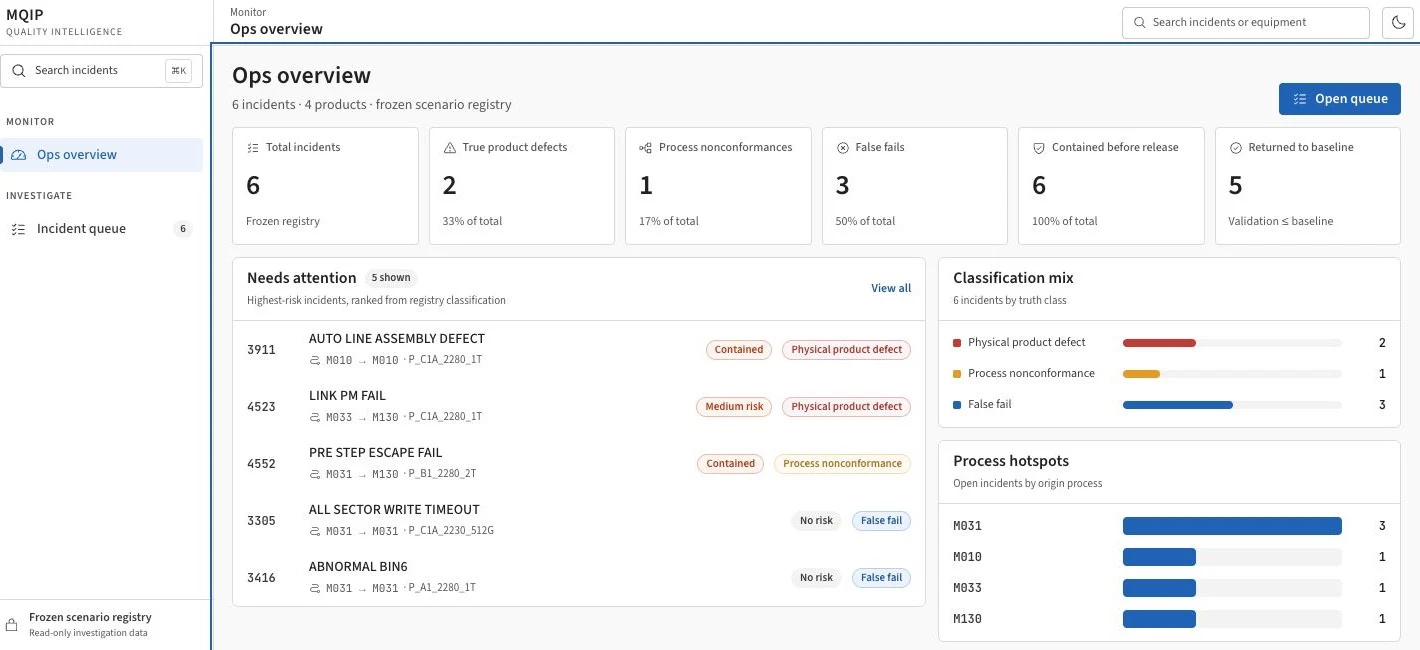
MQIP operations overview showing quality incidents, product-defect classifications, process hotspots, containment status, and return-to-baseline metrics.
  • FastAPI + ReactDeployed full-stack investigation workflow
  • Grounded RCA recommendationsStructured output tied to reviewable evidence
  • Validated AI boundariesSchema, taxonomy, provenance, and grounding checks
  • Real quality investigationHardware, waveform, dimensional, and screening analysis

Selected Work

Two projects, one engineering direction

Software systems built from real manufacturing-quality questions, paired with the investigation work that shaped them.

Flagship Product · Full-Stack AI

Manufacturing Quality Intelligence Platform

A deployed full-stack AI platform that connects structured manufacturing evidence, grounded RCA recommendations, human engineering review, corrective-action tracking, and effectiveness validation in one traceable workflow.

  • Structured incident and evidence workflow
  • Grounded RCA recommendations with server validation and human review
  • Corrective-action tracking and effectiveness validation
  • Python 3.12
  • FastAPI
  • React + TypeScript
  • PostgreSQL
  • AI provider integration
  • Cloud Run
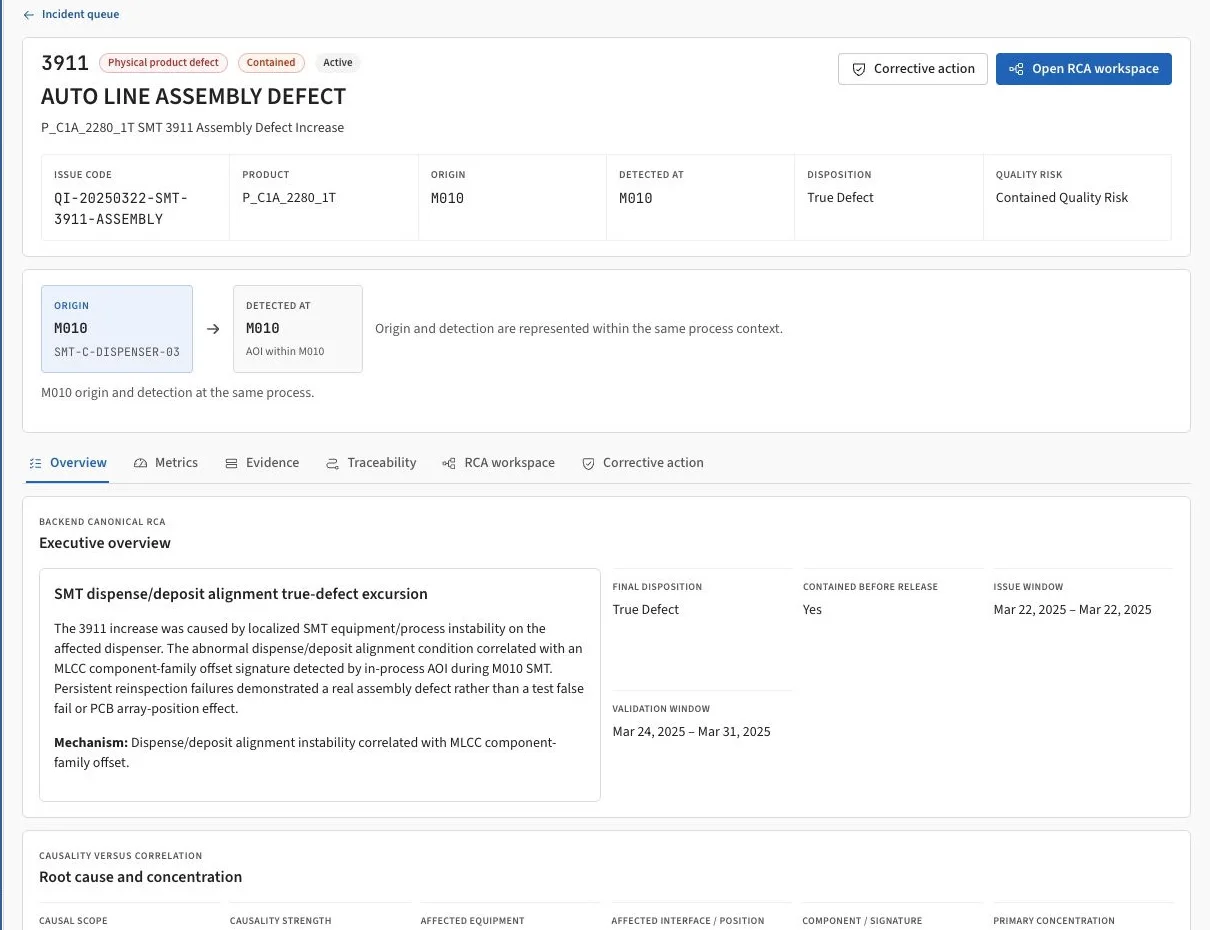
MQIP investigation workspace showing an assembly-defect executive overview, root-cause explanation, mechanism, and engineering context.
Structured investigation connects manufacturing evidence to a reviewable root-cause explanation and mechanism.

Validated result

11 ppm → 2 ppmConfirmed cases / units: 122 / 11.37M → 22 / 9.33M · p < 0.001

Real Manufacturing Quality Case · 2023

M.2 SSD FET Burnout Root Cause Analysis and Screening Improvement

Traced intermittent FET burnout to conductive debris and PCB/socket alignment risk, identified a gap in late-stage interface testing that could miss affected units, and helped reduce the collected and confirmed burnout rate from 11 ppm to 2 ppm.

  1. 01Occurrence-and-escape causal-chain analysis
  2. 02Hardware, waveform, dimensional, and screening evidence
  3. 03Screening-program improvement and cross-functional corrective actions
  4. 0411 ppm → 2 ppm with exact statistical validation
Read the Investigation
View all projects

What I Build

Systems for the full investigation loop

  1. AI-Assisted Quality Systems

    Grounded RCA recommendations, structured provider outputs, evidence provenance, validation boundaries, and human engineering review.

  2. Manufacturing Digitalization & Data Systems

    Engineering workflow systems, manufacturing data integration, quality analytics, anomaly detection, yield movement analysis, equipment patterns, and corrective-action validation.

  3. Full-Stack Engineering

    Python APIs, React and Vue applications, relational data models, authentication, automated testing, observability, and cloud deployment.

System Design

Selected Engineering Decisions

The implementation details matter, but so do the trade-offs behind them.

Why AI-assisted RCA recommendations require a controlled taxonomy

Context
Free-form model output can sound plausible while producing inconsistent or operationally unusable root-cause categories.
Decision
Constrain RCA recommendations to a controlled manufacturing taxonomy and validate each structured response before it can be accepted.
Trade-off
Reduced linguistic flexibility in exchange for consistency, auditability, and downstream workflow compatibility.

Why evidence provenance matters in AI-assisted investigations

Context
An RCA recommendation is difficult to trust when engineers cannot trace it back to the data and observations that support it.
Decision
Preserve evidence references and separate observed facts, inferred causes, and recommended next actions.
Trade-off
Additional data modeling and UI complexity in exchange for reviewability and engineering trust.

Designing observability for structured AI-output failures

Context
Provider calls can succeed at the transport layer while still returning invalid schemas, unsupported categories, or incomplete evidence mappings.
Decision
Log and classify validation failures at explicit system boundaries while keeping sensitive provider payloads and reasoning traces out of production-facing output.
Trade-off
More validation and diagnostics code in exchange for faster debugging and safer production behavior.

Career Progression

From failure investigation to quality intelligence systems

My work evolved from investigating individual manufacturing failures to building digital workflow and AI systems that make quality signals visible, explainable, and actionable.

  1. 01Semiconductor Test Engineering
  2. 02Manufacturing Quality & Yield Analysis
  3. 03Factory Digitalization & Full-Stack Workflow Systems
  4. 04Applied AI for Quality Engineering
View the full journey

Engineering Proof

Evidence over adjectives

Current test results, explicit validation boundaries, and measured quality outcomes.

150 passing
Backend testsAPI, quality metrics, scenarios, RCA, taxonomy, and validation contracts.
36 passing
Frontend testsAPI client, incident views, evidence drill-down, and RCA workflow behavior.
Validated output
AI system boundariesSchema, taxonomy, provenance, and grounding checks before a recommendation can be accepted.
11 ppm → 2 ppm
Collected / confirmed burnout rateObserved after the combined countermeasure package; one-sided Fisher’s exact test, p < 0.001.
Workflow systems
Manufacturing digitalizationBuilt full-stack internal workflow systems for manufacturing evaluation processes.

Explore by Focus

Three connected engineering paths

Full-Stack AI Engineering

Explore the platform architecture, AI workflow, validation strategy, and full-stack implementation.

Explore Full-Stack AI Work

Manufacturing Digitalization Engineering

Explore Python-based manufacturing applications, engineering workflow systems, manufacturing data integration, and digital process improvement.

Explore Manufacturing Systems Work

Product Quality Engineering

Explore hardware failure analysis, waveform and screening investigation, dimensional capability, occurrence-and-escape analysis, and corrective actions supported by before-and-after statistical evidence.

Explore Quality Engineering Work

Contact

Let's build systems that make engineering decisions clearer.

Open to full-stack AI, manufacturing digitalization, manufacturing data, and product-quality engineering opportunities.

Get in touch

Or email me directly