Manufacturing Quality Intelligence Platform with Grounded RCA Agent
Transforms fragmented manufacturing-quality evidence into a traceable workflow—from incident triage and evidence review to an AI-assisted RCA recommendation, human engineering review, corrective-action tracking, and effectiveness validation.
Overview
MQIP is a cloud-native manufacturing-quality platform that brings incident triage, structured evidence review, AI-assisted root-cause analysis, human engineering review, corrective-action tracking, and effectiveness validation into one traceable workflow.
The platform combines a React investigation workspace, typed FastAPI services, a relational quality-data model, constrained AI-provider integration, server-validated evidence references, managed cloud deployment, and controlled baseline and scenario initialization.
My contribution covered the end-to-end product workflow, application architecture, backend APIs, frontend experience, evidence-grounding contract, provider orchestration, cloud deployment, observability, and automated verification. Engineering judgment remains responsible for accepting or rejecting each recommendation and connecting it to a separately recorded corrective action.
Problem
Manufacturing quality investigations rarely depend on one chart. Engineers combine yield movement, defect PPM, lot and unit concentration, equipment patterns, process history, test outcomes, upstream and downstream roles, corrective-action records, and validation-window behavior. When those signals are fragmented across tools and records, preserving evidence lineage and decision context becomes difficult.
The engineering problem was to turn those inputs into a reviewable workflow while constraining an AI recommendation to evidence that the server can resolve and validate. The AI layer supports investigation; it does not determine root cause autonomously or replace quality-engineering judgment.
Investigation Workflow
Incident triage → Evidence review → AI-assisted RCA recommendation → Human engineering review → Corrective-action tracking → Effectiveness validation
The application structures the investigation before any provider call. A user opens an incident, reviews severity and defect movement, follows lot-to-unit process lineage, distinguishes suspected origin from detection, and compares baseline, issue, and validation windows. The assembled context includes process and equipment events, traceability, test history, bounded evidence rows, corrective-action records, and explicit evidence limitations.
The provider recommendation and the corrective-action record remain separate workflow artifacts. An engineer reviews the structured recommendation before accepting it or connecting it to an action. Post-action metrics are then compared with the issue period to assess effectiveness and recurrence.
What the AI Layer Does
- The application assembles typed incident evidence before creating a provider request.
- The configured provider receives bounded evidence and limitations as context, not the expected scenario answer.
- The provider returns a constrained RCA recommendation with classification, process roles, causal chain, confidence, limitations, corrective-action assessment, and evidence references.
- The asynchronous API streams workflow and status updates to the frontend while provider processing continues; these are progress events, not token-by-token model output.
- The server validates the final structured response, and an engineer reviews it before acceptance or corrective-action linkage.
No custom model was trained. The engineering focus was provider integration, evidence grounding, constrained structured output, workflow reliability, and human review. This is LLM application engineering rather than supervised model training: the project has no training loss, custom fine-tuned model, or claimed model-accuracy business metric.
Evidence boundary and hidden evaluation
Expected classification, origin and detection processes, required concepts, prohibited claims, and scenario-specific correctness criteria remain outside provider-visible prompts and tool results. Hidden evaluation runs only after schema, taxonomy, self-consistency, process-role, provenance, unsupported-statistical-claim, and evidence-grounding checks pass. The model receives evidence, not the expected answer.
A response can satisfy structure and grounding checks while still reaching a semantically weak conclusion. The server preserves that model-quality result rather than silently replacing it with the expected answer. Provider or validation failures are not represented as accepted conclusions, and the page makes no claim of automatic retry behavior.
Machine-verifiable evidence references
Each provider-generated reference contains a canonical tool_name and an RFC 6901 JSON Pointer path. The server confirms that the tool ran, checks that the path appeared in the referenceable catalog, resolves the scalar from the exact model-visible evidence snapshot, attaches a server-owned display label, and returns the resolved value. Duplicate, unavailable, container, or invalid references are rejected.
This contract reduces the risk of rounded, reformatted, altered, or hallucinated copied values. It provides server-resolved, machine-verifiable references; it is not cryptographic proof of causality.
Taxonomy alignment
PROCESS_NONCONFORMANCE means a required process state, record, control, verification, or manufacturing requirement is missing, invalid, unmaintained, or unverifiable. PROCESS_ESCAPE requires an independently established defect or nonconformance to pass an intended detection, containment, or control step. Downstream detection alone does not prove process escape.
In one controlled live 4552 acceptance, the provider returned PROCESS_NONCONFORMANCE, origin M031, detection M130, and HIGH confidence. All 12 references were accepted, the server did not overwrite the conclusion, and hidden evaluation passed. This is one acceptance case—not a universal accuracy claim, proof that all six scenarios received live-provider validation, or a guarantee that future responses will pass.
Architecture
The runtime request path moves from the user through the React frontend on Cloudflare Pages to the FastAPI service on Cloud Run. The API reads and writes Neon PostgreSQL and invokes the configured AI provider through a typed adapter. Database and provider credentials remain behind the API boundary.
The provider abstraction includes a DeepSeek Chat Completions adapter and an OpenAI Responses-compatible adapter. Both target the same structured analysis contract, keeping provider-specific transport separate from evidence assembly, validation, and human review.
Cloud Run Jobs sit outside the user request path and web-service startup. They run controlled Alembic schema migration and baseline/scenario initialization for the baseline dataset and six quality-investigation scenarios. Artifact Registry, Secret Manager, and Cloud Logging support build, secrets, and structured diagnostics without adding unused runtime infrastructure.
The model receives investigation evidence, not the expected answer.
- Artifact Registrycontainer artifact
- Secret Managerserver credentials
- Cloud Run Jobsschema migration · scenario initialization
- Cloud Loggingstructured JSON logs
Data Model and Scenario Design
The initialized baseline contains 1,218 production-lot records, 10,000 PCB arrays, 80,000 detailed array units, and exactly 4,000,000 represented lot units. It also contains 276,415 baseline test runs and 2,124 baseline test-failure rows, providing large-scale analytical coverage for repeatable investigation and validation.
Six controlled quality-scenario overlays introduce physical defects, false-fail conditions, process nonconformance, equipment-related abnormality, upstream origin with downstream detection, corrective-action tracking, and validation behavior.
Key Screens
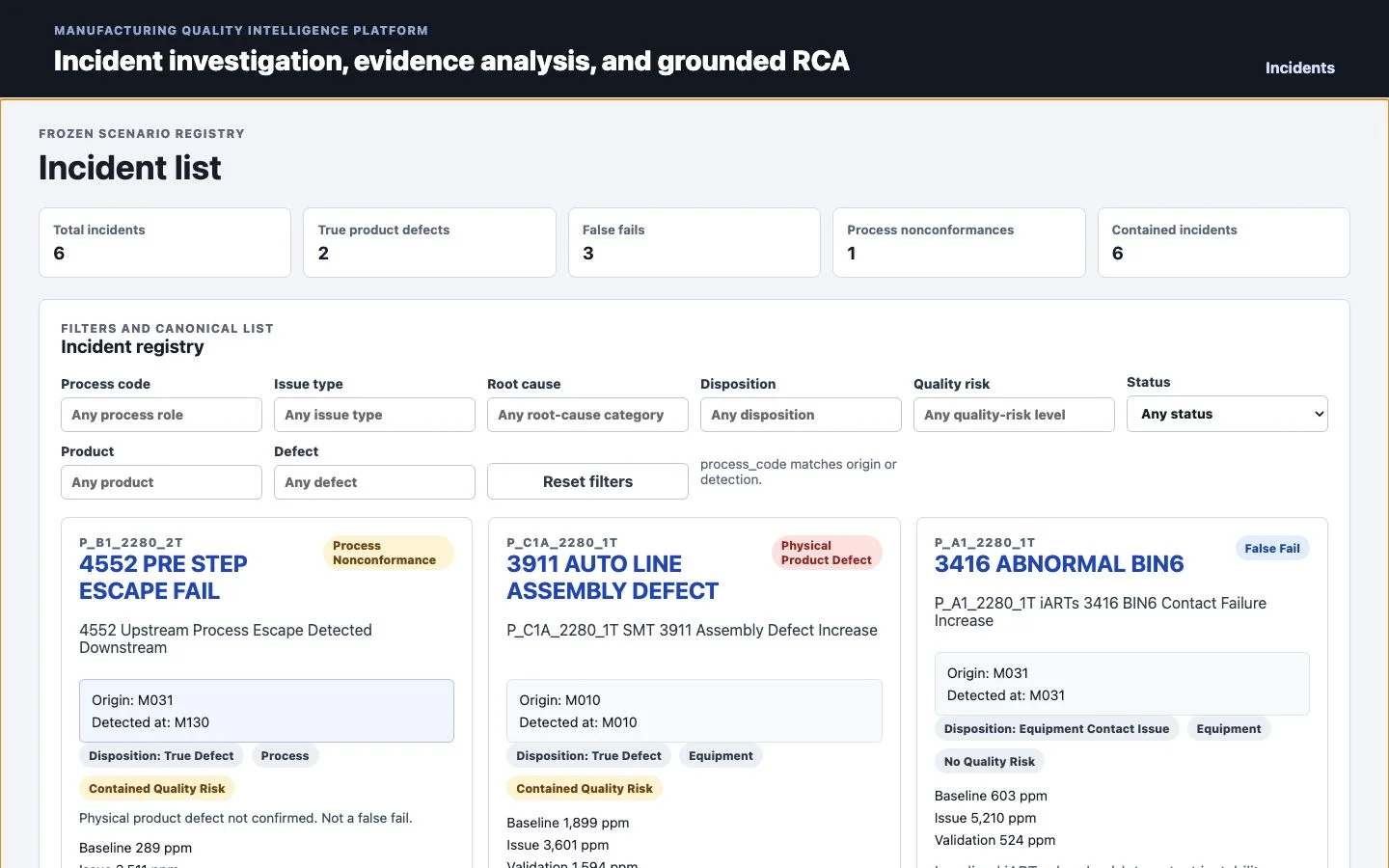
The incident registry gives engineers one review queue for comparing severity, defect movement, process roles, investigation state, and validation status before opening the detailed evidence workspace.
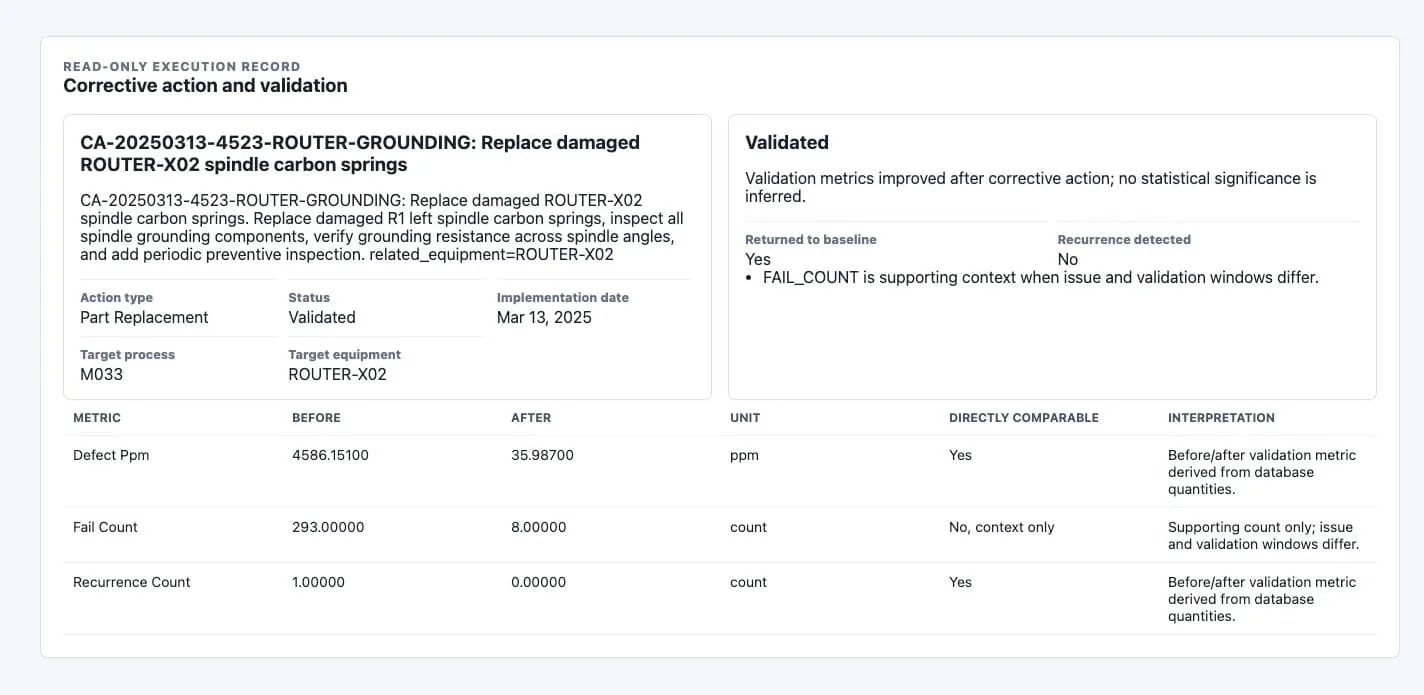
The corrective-action view keeps the intervention record separate from the provider recommendation and evaluates it against comparable issue and validation windows.
Operational Characteristics
Cloudflare Pages serves the frontend, Cloud Run serves the FastAPI API, and Neon supplies PostgreSQL over pooled TLS connections. The deployment uses managed container artifacts and server-side secret injection; credentials never become browser variables. Production raw RCA debug capture is disabled.
Cloud Run is configured with zero minimum instances and one maximum instance. Liveness performs no database or provider work; readiness checks database connectivity and the applied Alembic head. Request-correlated JSON logs record route, method, status, latency, and bounded RCA validation categories without provider content, prompts, reasoning, evidence rows, credentials, or connection strings.
The deployed cloud environment exposes the six-incident registry and detailed investigation views. In one controlled live-provider run, the request completed with HTTP 200 and emitted request-correlated structured logs, confirming the deployed path across the frontend, API, database, provider integration, validation pipeline, and rendered response.
The asynchronous RCA path exposes streamed workflow-status feedback so processing remains visible while the provider request runs. The final structured recommendation is separate from those progress events and still requires server validation and human review. Observed end-to-end investigation latency was approximately 49 seconds: a current runtime characteristic and provider-latency optimization opportunity—not an SLA, performance achievement, or cross-provider benchmark. The measured path includes provider latency; provider/model selection, context size, and asynchronous execution remain optimization opportunities.
Engineering Challenges and Decisions
Keep investigation evidence and expected truth separate.
Providing the expected classification or process roles to the model would turn the RCA agent into a report formatter. The provider receives objective evidence; scenario expectations remain server-side and run only after online validation.
- Inject canonical conclusions server-side
- Expose expected truth in provider context
- Accept ungrounded narrative output
Resolve evidence values on the server.
A tool name and RFC 6901 pointer can be checked deterministically against the exact model-visible snapshot. Model-copied numbers and text can be rounded, reformatted, altered, or hallucinated.
- Allow free-form citations
- Require the model to copy exact values
- Accept references without pointer validation
Preserve model-quality failures.
A response can be schema-valid and grounded while choosing the wrong taxonomy label. That is a model-quality result, not necessarily an infrastructure failure, so the server does not overwrite the provider conclusion with the expected answer.
- Overwrite the model classification
- Treat every hidden-evaluation mismatch as a provider failure
- Remove classification from provider output
Separate web startup from migration and initialization operations.
Schema migration and baseline/scenario initialization are controlled deployment operations, not responsibilities of each web-process startup.
- Run Alembic on every service boot
- Initialize during Cloud Run startup
- Populate the deployed database manually from an application request
Add production-safe structured diagnostics.
Full provider output is unsafe to log, while a generic 502 is insufficient for schema debugging. Structured diagnostics retain request correlation, event and validation categories, provider/model identifiers, safe constraints, input type, and input length without prompts, provider content, reasoning, evidence rows, credentials, or database connection values.
- Log full provider responses
- Retain only generic error messages
- Enable raw debug artifacts in production
Engineering Outcomes
- 4,000,000 represented unitsQuality data scale
- 6 scenariosInvestigation coverage
- 12 / 12 referencesMachine-verifiable evidence
- 150 backend · 36 frontendAutomated verification
Delivered a deployed React frontend, typed FastAPI API, PostgreSQL data model, AI-provider integration, controlled migration and scenario-initialization jobs, structured observability, and six repeatable manufacturing-quality investigation scenarios. The platform provides an end-to-end, evidence-grounded, human-reviewed quality-investigation workflow with independently managed deployment, initialization, and operational diagnostics.
Limitations
- The deployed platform is evaluated through a controlled baseline and six quality-investigation scenarios. It is not integrated with a live MES or QMS and makes no claim of factory adoption.
- The project evaluates software architecture, evidence traceability, provider integration, workflow reliability, and human-review controls; measured production yield, defect, and investigation-cycle improvements were outside the project scope.
- No custom ML or LLM model was trained or fine-tuned. There is no training loss or claimed business-accuracy metric, and a schema-valid, grounded response can still select the wrong taxonomy label or reach a semantically incorrect conclusion.
- Only selected scenarios received controlled live-provider acceptance runs. The 4552 result is one bounded acceptance case—not a universal accuracy claim, proof that all six scenarios received live-provider validation, or a guarantee that future responses will pass.
- AI output is probabilistic decision support. An engineer reviews each recommendation before acceptance or connection to a separately recorded corrective action; the system does not determine root cause autonomously.
- Mandatory investigation context is preloaded, while bounded optional provider tool calls can request additional read-only evidence. Expected answers and scenario-specific correctness criteria remain outside provider-visible context.
Methods & Tools
- Python
- FastAPI
- React
- PostgreSQL
- Alembic
- Cloud Run
- Cloudflare Pages
- Neon
- Secret Manager
- Cloud Logging